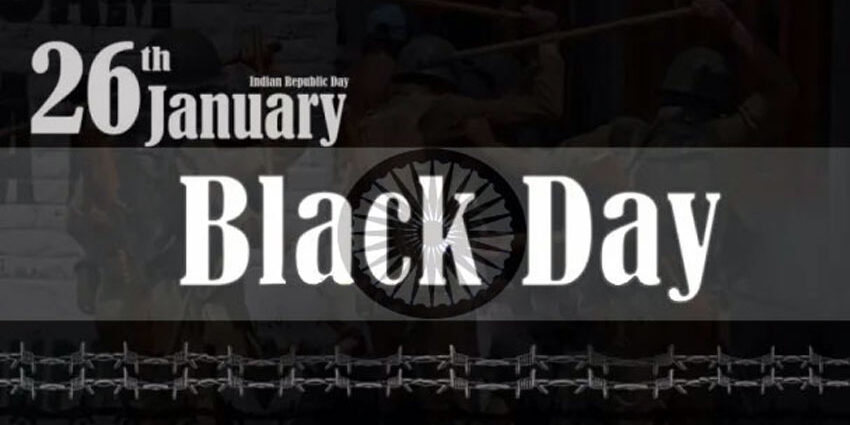
January 26: Kashmir’s Black Day
Why the Heart of IIOJK Refuses the Call to Celebrate
Every year on the 26th of January, when New Delhi is enamored by national celebrations, another reality unfolds in Indian Illegally Occupied Jammu and Kashmir. For the millions of Kashmiris of this historically disputed region, this day does not signify the inception of a republic; rather, it marks a “Black Day”. It is a day of collective mourning. Whilst the Occupation scrambles to paint a narrative of normalcy in tricolors, the people of Kashmir hoist black flags to manifest defiance. The dissent draws a sharp contrast between the rhetoric of republicanism and the reality of prolonged military presence that is suffocating the valley. The silence of the people of Kashmir communicates that their identity cannot be erased by rewriting maps.
The Observation of Black Day in IIOJK is not merely symbolic; it represents a deliberate political assertion. It underscores the reality that a constitution, regardless of its eloquence and intent, loses its ethical standing when it is used to institutionalize control instead of ensuring justice. For Kashmiris, 26 January is any other day of enforced stagnation under constant surveillance. While one side of the border celebrates “Gantantra Diwas”, the people of Kashmir find themselves caged within a system that treats repression as a permanent norm.
This stark contradiction is the tragedy of Kashmir. A so-called republic commemorates its inception on a territory where the foundational republican spirit of the sovereignty of the people to shape their own political destiny is violently denied.
The Occupation argues that the pervasive military deployment in IIOJK is a domestic matter necessitated by regional security threats and economic priorities. They frame the abrogation of regional autonomy as a strategic move towards integration and development of a marginalized territory. Yet this claim is marked by absence of both empathy and legitimacy. Development cannot be delivered under the barrage of bullets, nor can a population be integrated without consent. To argue that infrastructure investments can substitute the fundamental human right to self-determination is to propose that material progress can compensate for dignity. Economic pacification is not a replacement for political self-rule.
Furthermore, this argument of “internal conflict” holds no value once viewed through the lens of ‘normative internationalism’. The United Nations has long recognized the Kashmir issue as an international dispute and not a domestic issue to be resolved by unilateral actions of a central authority. Since 1947, Kashmir has been a territory awaiting a final ruling; an internationally recognized promise preserved in United Nations resolutions calling for a plebiscite. That vote never took place. By refusing to concede the international character of the issue, India is engaging in ‘Diplomatic Decoupling’ from the rule-based order the world claims to respect. By observing Black Day, Kashmiris are telling the global conscience that demographic engineering cannot erase their distinct identity.
With more than 434 internet shutdowns in the last 13 years alone, the daily horrors of the Kashmiris remain hidden under information blockade and pervasive misinformation by the occupation, while the world is made to see carefully staged images of normalcy. Confinement without trial, forced disappearances, suppressing local and independent journalists, and criminalizing dissent have engulfed the region in silence largely mistaken for consent. To categorize unmarked graves, disappeared fathers and sons, detained students, half widows, and generations growing up with checkpoints and curfews as statistics is inhumane. They are the day-to-day realities of people living in IIOJK. Black Day exists as a reminder that every number is a human life.
To move beyond annual mourning of Black Day requires our focus to shift from territory to people. The issue cannot be reduced to a bilateral conflict between two nuclear states; solutions must centre on the will of the Kashmiri people. With approximately 1 security personnel for every 8 civilians, the priority is to start with reducing the overwhelming military presence in the region, followed by revocation of draconian laws that are providing impunity, like the Public Safety Act (PSA) and the Armed Forces Special Powers Act (AFSPA).
Transparency, as a confidence-building measure, is crucial. The establishment of an independent, UN-mandated human rights monitoring commission within IIOJK is a prerequisite of fair conversion. Providing international observer groups unhindered access would serve as a normative anchor, ensuring that justice is upheld in the transition from occupation to a politically self-regulated state. Lastly, the solution must centre on the “state-of-the-art sovereignty model”. We should delve into political arrangements exceeding the zero-sum games of the 20th century. Any Unilateral approach to the issue jeopardizes the lives and rights of millions of Kashmiris.
Rectification of the Kashmir issue revolves around the ‘restorative justice’ approach. The harm done in the past must be confronted. Escaping the cycle of suffering necessitates addressing the former atrocities perpetrated by the Occupation apparatus and the oppressive structural disposition of the present.
The observation of Black Day is a silent cry for principled intervention. It is a beckoning to the global conscience to look beyond the festive parades and flamboyant pageantry and be witnesses to the “invisible occupation”. It is a request to the global community to depart from oratory sympathy and advance towards consequential actions. The 26th January symbolises a mirror that reflects the gap between the declarations of human rights and the particular refusal of those rights in the valley.
We envision a future where 26th January is no longer marked by darkness. We strive for a time when the people of IIOJK memorialize their freedom and celebrate their identity, when the land is guarded by its people and not by foreign enforcements. Until then, Black Day will be observed to reveal the paradox of democratic rhetoric and the reality of IIOJK. Black Day is a manifestation of the enduring dissent of the Kashmiri people. The “Kashmir Knot” can be untied but only if the hands holding the rope are inclined to prioritize the pulse of IIOJK over the rigid lines of a map.
Until force yields to justice and domination to dignity, Black Day will be commemorated, not by choice, but by the relentless necessity for truth.
By Syeda Emaan Fatima, Junior Researcher at YFK